AGS Conference 2026
University of Glasgow
The 94th Conference of the Association for German Studies took place in person in the Gilbert-Scott-Building at the University of Glasgow, from 26-28 August 2026. The lead panel was on the topic of Environments.
Thanks to all speakers, delegates and, especially, to the organisers!
You can view a series of Bluesky posts capturing some of the key moments from the conference here:
ARCHIVED MATERIALS
Conference Programme
Lead Panel
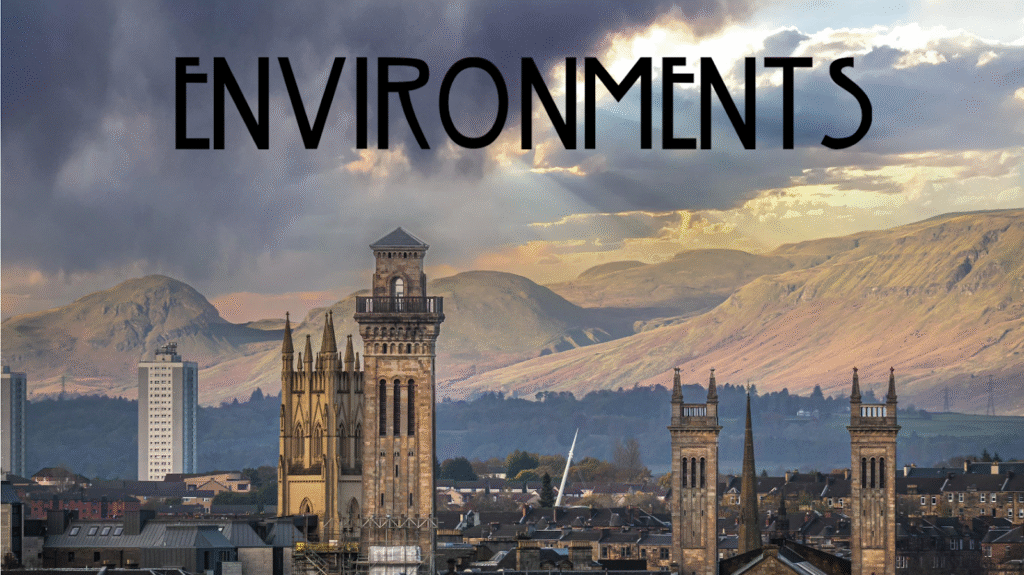
ENVIRONMENTS
Glasgow, the “dear green place” protected by the miracles of St Mungo and surrounded by the firths and lochs of Scotland’s West Coast, fifth largest urban area in the UK and a visionary place for art and architecture, UNESCO City of Music and host city of the 2021 United Nations Climate Change Conference (COP26), is pleased to host AGS26 and invites contributions to thinking about environments and environmental German Studies in the narrower and wider sense.
In the narrower sense, the lead panel would like to explore how the latest influences of new materialism, human life and art in the Anthropocene, and ecological thought can inform German Studies, as well as social, cultural, political life and thought in the German speaking world. At the ecological end of the spectrum, this may include inter- and cross-species solidarity and encounters (plants, animals, minerals etc.), blue humanities (water studies) and practices of walking, imagined and emotional landscape writing, and nature escapism. Within the rural-urban borderlands, papers could explore anthropogenic worldmaking, the rewilding of the built environment, “climate resilience”, as well as phenomenological approaches to environmental perception: corporealities, affect, emotion, ambience, atmosphere, resonances.
In a wider thematic sense, the lead panel also wants to ask what kind of environments foster or inhibit social interaction. With Glasgow having been the centre of migration into and within Scotland for the past 150 years, and experimental ground for housing projects, and an overlapping zone with Northern Ireland, the city may inspire papers to explore what kind of urban, rural and natural environments, spaces and places contribute to questions of urban and social justice. With climate and housing crises at moments of impasse, what kind of environments can foster transnational and cross-cultural encounters – in short: how and in which sectors can our cultural and historical knowledge inspire ideas for futurity in our crisis-ridden times? How do social inequalities shape the national imaginary in relation to perspectives on urban development, environmental policy and activism, and how do we examine the intersections of space, nature and civilization to narrate, depict and understand some of the most pressing issues of the 20th and 21st centuries?
In an even wider sense, the conference also wishes to continue the forum where we can discuss questions around the nature of the discipline and professional practices: what kind of professional environments do we need to thrive, preserve, and adapt our research and teaching practice? What forms of collaboration may we require to face issues of student recruitment, workloads, and closures of entire schools? How can we promote what we do best and what makes our profession future-proof, i.e. thinking outside the monolingual box and making close connections between languages, disciplines, cultures and people? Not least, what kind of pedagogical environments do we need to create and nurture for more sustainability-focused curricula?
Conference Registration
Conference Fee
To register and pay the conference fee in GBP, click here:
To register and pay the conference fee in EUR, click here:
PG Conference Fee
To register and pay the reduced postgraduate conference fee in GBP, click here:
To register and pay the reduced postgraduate conference fee in EUR, click here:
How to sign up for the AGS 2026 conference…
- All delegates need to register by paying the conference fee. There is a reduced fee for postgraduate students. By following the respective links, the conference fee can be paid either in GBP or in EUR. Please remember that you need to be an AGS member to attend the conference. You can become a member on the Membership page of this website.
- There is also a link to an Eventbrite page to sign up for a critical city walking tour on the Thursday evening.
- Finally you can follow the link below to book accommodation at Queen Margaret Residence for the duration of the conference. To book at the negotiated discounted rate, remember to use the promotion code “AGS26″.
If you would you like to take part in the critical walking tour by Dr Rosie Spooner “Tracing Glasgow’s Imperial Past in Kelvingrove Park” on Thursday evening (5.15-6.30pm), please sign up here. The tour is free but signing up in advance is essential as spaces are limited.
A contingent of 90 ensuite, non-catered single rooms has been reserved at Queen Margaret Residence (£46.50 per room, per night) and can be booked for a maximum of four nights (25-29 August). The residences are an approximate 25min walk from the venue with plenty of coffee shops, restaurants and bars on the way.
The promotion code is AGS26
Call for Papers
We now invite abstracts for 15-20-minute papers (or other forms of presentations) to be presented at the 94th Conference of the Association for German Studies which will take place in person at the University of Glasgow, 26-28 August 2026.
Papers are welcome under any of the panels listed below. If you are interested in contributing a paper to one, please send your abstract directly to the email address of the relevant convenors associated with the relevant panel. All submissions should be in the form of a title with a 150-250-word abstract and be accompanied by a short bio with current affiliation (where applicable).
If you would like to submit a paper that does not fit under any of the panels below, please send it to for consideration for a general panel. Abstracts should reach the relevant convenors no later than 20 February 2026. The following panels invite contributions:
A PDF file of the CfP can be found at the bottom of this page.
—
Lead Panel:
ENVIRONMENTS
Glasgow, the “dear green place” protected by the miracles of St Mungo and surrounded by the firths and lochs of Scotland’s West Coast, fifth largest urban area in the UK and a visionary place for art and architecture, UNESCO City of Music and host city of the 2021 United Nations Climate Change Conference (COP26), is pleased to host AGS26 and invites contributions to thinking about environments and environmental German Studies in the narrower and wider sense.
In the narrower sense, the lead panel would like to explore how the latest influences of new materialism, human life and art in the Anthropocene, and ecological thought can inform German Studies, as well as social, cultural, political life and thought in the German speaking world. At the ecological end of the spectrum, this may include inter- and cross-species solidarity and encounters (plants, animals, minerals etc.), blue humanities (water studies) and practices of walking, imagined and emotional landscape writing, and nature escapism. Within the rural-urban borderlands, papers could explore anthropogenic worldmaking, the rewilding of the built environment, “climate resilience”, as well as phenomenological approaches to environmental perception: corporealities, affect, emotion, ambience, atmosphere, resonances.
In a wider thematic sense, the lead panel also wants to ask what kind of environments foster or inhibit social interaction. With Glasgow having been the centre of migration into and within Scotland for the past 150 years, and experimental ground for housing projects, and an overlapping zone with Northern Ireland, the city may inspire papers to explore what kind of urban, rural and natural environments, spaces and places contribute to questions of urban and social justice. With climate and housing crises at moments of impasse, what kind of environments can foster transnational and cross-cultural encounters – in short: how and in which sectors can our cultural and historical knowledge inspire ideas for futurity in our crisis-ridden times? How do social inequalities shape the national imaginary in relation to perspectives on urban development, environmental policy and activism, and how do we examine the intersections of space, nature and civilization to narrate, depict and understand some of the most pressing issues of the 20th and 21st centuries?
In an even wider sense, the conference also wishes to continue the forum where we can discuss questions around the nature of the discipline and professional practices: what kind of professional environments do we need to thrive, preserve, and adapt our research and teaching practice? What forms of collaboration may we require to face issues of student recruitment, workloads, and closures of entire schools? How can we promote what we do best and what makes our profession future-proof, i.e. thinking outside the monolingual box and making close connections between languages, disciplines, cultures and people? Not least, what kind of pedagogical environments do we need to create and nurture for more sustainability-focused curricula?
The organisers specifically conceive the lead panel to be interdisciplinary and diachronic, so research and scholarship from any German-related discipline as well as period and teaching practice is welcome. We also specifically welcome creative and experimental presentation and communication formats that encourage us to think outside the box of the usual 15-20min research paper.
—
As in past years, the conference programme includes the following Recurring Panels.
Please note: scholars in medieval studies are encouraged to apply to all panels including the lead panel.
Linguistics and Language Studies
This panel invites papers related to any aspect of German and Germanic linguistics and language studies, including comparative studies, Deutsch als Fremdsprache and language-focused translation studies. Papers may deal, for example, with diachronic linguistics or trends in current usage, second language acquisition, language pedagogy, language policy, sociolinguistics and (critical) discourse analysis.
Adaptation / Translation
We are interested in all forms of intermediality in which themes, plots, and motifs transfer from one mode or genre to another. In particular, we invite submissions which deal with literary texts becoming films or graphic novels, or transforming into other analogue, visual or digital media; or with translations to or from German and the attendant theorisation of that translation.
Centring Marginalised Perspectives (on behalf of Women+ in German Studies and the AGS Working Group on Equity, Diversity and Inclusion)
Convenor: Christiane Schönfeld ()
This panel will centre marginalised perspectives and areas of scholarship, bringing together scholars who work on or represent marginalised voices broadly within or adjacent to German Studies. We are interested in sharing and valuing experiences of research, scholarship or teaching practices that intersect with or challenge what has traditionally been seen as falling within the remit of the discipline. We welcome contributions relating to areas of study including, but not limited to, Trans and Queer Studies, Aging and Disability Studies, Decolonisation and Black Studies, Environment Studies, as well as new and emerging themes and approaches. We are welcoming broad themes as well as more focussed papers and will seek to find a format that will give the session depth and coherence once we see what papers have been offered. We will make this a safe and welcoming environment for speakers and participants to explore an inclusive approach to German Studies.
Eighteenth-Century Literature and Culture
This panel, although founded in studies of eighteenth-century German culture, broadly conceived (literature, theatre, visual culture, history, and until ca. 1830), invites papers that consider the period from a range of perspectives that inform research in German Studies more generally. Possible approaches include, but are not limited to, perspectives on colonialism (including interactions with East-Central Europe); German and the world or the planetary; ecocriticism and the Anthropocene; gender. Comparative perspectives as well as work on the reception of this period (including in film) are also welcome.
Nineteenth- and Early-Twentieth-Century Studies
Papers are invited on any aspect of the culture of German-speaking countries in the nineteenth century and earlier decades of the twentieth century (up to about 1930), including literature, theatre, visual and musical culture and thought.
‘National Postgraduate Colloquium in German Studies Emerging Scholars Panel‘
The National Postgraduate Colloquium in German Studies is pleased to be organising a panel for the second year running with the AGS. We invite papers from postgraduate students and early career academics working on any aspect of German Studies, including all periods of literature, the arts, social sciences, history, and linguistics. Presentations of 10-15 minutes with time for feedback and questions will bring together postgraduate and early-career academics to exchange ideas and share their emerging research. Papers can be a work in progress, and we especially welcome first-time presenters or new papers from postgraduates and early career academics about a developing element of their research. We welcome new perspectives both as part of the papers presented and in the discussion afterwards.
Please note: the organisers will run a separate call for papers in May 2026.
—
This year’s conference will also include the following Special Panels.
Political Mass Movements in German-language Cultural Production
Convener: Katherine Calvert ()
Cultural production, including literature, visual culture and performance art, has long provided a platform through which creative practitioners can intervene in political discourses. This panel investigates the portrayal of political mass movements in German-language cultural production, ranging from critical depictions of mass movements (for instance, Weimar-era critiques of the rise of National Socialism) to sympathetic or explicitly agitational and propagandistic works (for instance, Epic Theatre productions). This panel invites papers that explore the poetics and aesthetics of political mass movements across media, causes/ideologies and historical periods, and asks how style and genre capture, imagine or critique the ideologies and experiences of mass politics.
This panel further welcomes engagement with topics including (but not limited to) the relationships between individuals and collectives, how marginalised voices can be (re)integrated into mass movements, and, dovetailing with the theme of the lead panel, the embodied and affective experiences of political spaces.
Posthumous Authorship
Convenors: Ian Ellison, Stefanie Hundehege, Urs Büttner ()
This panel on Posthumous Authorship investigates the persistence of authorship after an author has passed away, often prematurely. It examines how philological, literary and theoretical traditions construct, manage, and contest the afterlives of writers and texts. From nineteenth-century forgery and editorial intervention to contemporary rediscovery and republication, the papers assembled here trace the diverse modalities of posthumous authorship (textual, editorial, medial, and conceptual) that emerge once authors are no longer alive to claim authority over their works.
Please note: access to this panel may be limited so please get in touch with the organisers if you wish to apply.
New developments and trends in Deutsch als Fremdsprache (DaF)
German language teaching plays an important part in German studies; like German as a discipline, language teaching had to adapt in recent years to new opportunities such as decolonising the language classroom or challenges such as AI, all of which required a profound rethink of the way we approach language teaching.
This panel aims to highlight recent developments and trends in teaching German as a foreign language in Higher Education, as well as its position within German Studies in the UK. We invite papers on all topics with teaching German language, such as AI for language learning, new and innovative designs in language assessment, adapting the language classroom to neurodivergent learner needs, or integrating intercultural competence to prepare students for global citizenship.
Interdisciplinary German Studies
The world of language studies is currently undergoing a dramatic shift as its relevance is repeatedly questioned by institutions and governments alike. While these developments pose many challenges, they are also an invitation for us to rediscover the crucial value of our discipline by exploring it within new contexts.
This panel invites and encourages speakers to present their interdisciplinary work; as long as part of the research focuses on aspects of German Studies, any discipline is welcome. This could include, for example, natural and social sciences, but also areas often perceived as being on the periphery of the academic remit, such as activism, gardening, or any form of creative practice.
Masculinity and the political environment – views from German-language culture
Conveners: Sarah Colvin and Alrik Daldrup (sjc269@cam.ac.uk)
The problem of masculinity in the contemporary political environment is anecdotally well known but under-articulated in literary scholarship. This panel will offer an opportunity to explore perspectives on masculinity and its discontents in recent German-language cultural production. Paper presenters, who will ideally be at a range of different career stages, will draw on the worlds represented in German-language cultural production to articulate and frame questions and issues of masculinity and masculinism.
Performance Practice in German Studies
Co-convenors: Joseph Prestwich and Godela Weiss-Sussex ( )
From Gotthold Lessing to Shermin Langhoff, theatre and performance have long been objects of analysis in German Studies research. The role of performance practice within the discipline, however, remains underexplored. In this panel, we invite speakers to reflect broadly on the use of performance practice in German Studies research. Following Diana Taylor (2016), we view performative practice as a potent and effective means of creating new knowledge. Far from being confined to “just” theatre, performance encompasses a wide range of embodied actions and social behaviours that aim to “create effects and affect [moving] between the AS IF and the IS, between pretend and new constructions of the ‘real’” (2016, 6). As such, we invite contributions from scholars making use of performance as part of their practice-based research, as a method for knowledge exchange and research dissemination, as a teaching tool in the Modern Languages classroom, and/or as a means of achieving research impact beyond the academy. Building on the theme of this year’s lead panel, we welcome explorations of academic “performance” and the function of everyday behaviours in bringing about institutional change.
Presentations can take the form of the usual 20-minute research paper, but we would strongly encourage creative communication formats, including short performative demonstrations or workshop activities. We welcome contributions from scholars working within any time period or any German-related discipline.
Please note: access to this panel may be limited so please get in touch with the organisers if you wish to apply.
Beyond Normativity: Neurodiversity in Law and Literature
The concept of neurodiversity has gained increasing attention across the humanities and social sciences, challenging pathologizing models of cognitive difference and foregrounding neurological variation as a fundamental aspect of human diversity. This panel starts from the premise that we are witnessing a changed social, cultural, and legal environment in which neurodiversity is increasingly acknowledged, named, and negotiated. Against this backdrop, the panel asks how German law and literature react to, shape, and open themselves to this changing environment. Contemporary German-language literature increasingly explores neurodivergent experience, with examples including Anja Baumheier’s Die Erfindung der Sprache, Brigitte Krien‘s Mein drittes Leben, Alina Bronsky‘s Pi mal Daumen, Elisabeth Beer’s Die Bücherjägerin, Laura Baldini’s Aspergers Schüler, and Sabina Bermann’s Die Frau, die ins Innerste der Welt tauchte. The panel invites contributions that engage with neurodiversity within the field of law, within the field of literature, or across both fields. Presentations may analyze how legal doctrines, institutions, and practices respond to neurodivergent subjects, as well as how literary texts register, imagine, or contest shifting understandings of cognitive difference.
Law, Politics and the Visual in Weimar Germany
Conveners: Steven Howe & Laura Petersen ()
This panel will showcase new perspectives on the entanglements of legal, political and visual culture during the period of the Weimar Republic. Extending the recent “interdisciplinary rethinking” (Kathleen Canning) of Weimar political culture, it brings together a collection of case studies that, from different disciplinary and conceptual positions, look at how visual practices are implicated in political meaning-making about law and justice, in forms of legal (re-)signification and subjectivization, and in shifts in the legal and political workings of affects and emotions. And at how visual culture is shaped, ordered and enabled – in conception as much as in articulation – by the authorization of law. Together, the contributions aim at deepening our understanding of the cultural lives of law and its power in and over cultural production during this intense moment of legal-political turbulence and media-historical change.
Please note: access to this panel may be limited so please get in touch with the organisers if you wish to apply.