Please see below a selection of reports from successful grant holders.
Joseph Prestwich, Elizabeth Ramsey, Dîlan Canan Çakir:
The two-day conference ‘Scenes of Play in German Literature from 1750’ took place at the Centre for Research in the Arts, Social Sciences and Humanities (CRASSH), University of Cambridge from 10–12 September 2026. Conceived as a launchpad for Play Studies in the UK, the event brought together academics from across disciplines to discursively engage with the topic of ‘play’ in German-language literary texts from 1750 to the present. We had speakers travelling in from eight different countries, and the full range of career stages was represented, from PhD candidates through to emeritus professors.
The range of topics covered was no less broad. To open the conference, Ben Angell, Narrative Lead at CaptureAge, gave the first keynote talk, providing a behind-the-scenes look into the writing and narrative design of a historical video game. Patricia Simpson (University of Nebraska-Lincoln) ended the first full conference day with a keynote addressing what she argued is the ‘invention’ of play during the German Romantic period. Catriona Macleod (University of Chicago) concluded the conference with a keynote talk that looked at the materiality of play, from cutouts and silhouettes to inkblots.
Beyond the keynotes, panels ranged widely across the philosophical, historical, and literary dimensions of play. Panels on philosophical enquiry moved from Kant and Lichtenberg through to Gadamer and Huizinga. Further sessions considered the utopian and revolutionary potential of children’s play in nineteenth-century Kindergärten, and the representation of games and gambling in literature and travel writing, from Parisian gaming tables and wooden building blocks to the video game Age of Empires II. Other panels examined plays themselves, tracing a line from Lessing and Schiller to the postdramatic theatre of Oliver Frljić, with particular attention to performative and metatheatrical strategies and to recurring themes of tragedy, morality, fate, freedom, and violence. Play as a literary technique was also explored in its own right, encompassing forms from choose-your-own-adventure narratives to layered narrative framings.
Across the two days, a number of shared concerns emerged. These included the transnational movement of people, ideas, and objects, and the intermedial and intertextual qualities of play (exemplified by Franz Blei’s films-within-films-within-plays); the performative and theatrical dimension of play, with recurring reference to Shakespeare, David Garrick, and Schiller’s and Goethe’s writings on acting and Schauspiel; and the question of how play itself is conceived and how that conception shifts over time and space. Discussions also turned repeatedly to materiality, whether that be the glass of Bruno Taut’s Dandanah or Robert Walser’s razor-sharp pencil or Kerner’s inkblots, and how this materiality can blur rationality, imagination, fantasy, and creativity. From gardens and lecture halls to metropoles and archives, we touched upon spaces of play, and how these might produce or disrupt social space. Finally, speakers repeatedly returned to play as a system of control, considering its role in regulating behaviour and reinforcing normative ideas of gender, labour, and canon, and probing the intersections between play, colonial imaginaries, and the political and aesthetic dimensions of its use.
A permanent link to the conference description and programme can be found here. We are grateful to the Association for German Studies, CRASSH, and the School of the Humanities and Social Sciences, University of Cambridge, for their generous support.
Lawrence Alexander:
The three-day conference, ‘Rethinking Weimar Cinema’, was held on 17th-19th June 2026 at Worcester College, Oxford. This event aimed to expand conversations and critical perspectives on film production of the period beyond familiar canons to encompass more recent archival retrievals and restorations, overlooked practitioners, and marginalized identities. The event brought together scholars, archivists, curators, and film restoration specialists from across Europe, North America, and South Asia with a programme that reflected the richness and diversity of responses to our Call for Papers. We were also fortunate to include three generative keynote talks from researchers who serve as touchstones for the conversations we hoped to facilitate during the conference. Dr Sara F. Hall (University of Illinois Chicago) presented an in-depth account of police films during the period; Dr Paul Dobryden’s (University of Virginia) keynote considered questions of selection and disposability across casting and production practices; and Dr Qinna Shen’s (Bryn Mawr College) presentation offered a survey of films constituting Fritz Lang’s ‘Asian obsession’. The sense of momentum that has emerged from this conference is clear and we anticipate that plans for publication projects will begin in earnest in the Autumn of this year.
As a complement to the conference programme, two public-facing screenings at Oxford’s Ultimate Picture Palace brought together conference delegates and members of the local community. These included a screening of Arnold Fanck’s Der heilige Berg (The Holy Mountain, 1926) introduced by Dr Ian Roberts as part of the Weimar 100 project and a new restoration of Richard Eichberg’s Song (1928) introduced by the man who restored it: Andreas Thein, Head of Collections and Restorations at the Filmmuseum Düsseldorf.
The conference was generously supported by the DAAD ‘Promoting German Studies’ grant, the Association of German Studies (AGS), the British Association of Film, Television, and Screen Studies (BAFTSS), the Leverhulme Trust, and Warwick Institute of Advanced Study. The conference organizers wish to thank all those who provided financial, logistical, and moral support to the organization of this event.

Mélissa Pires Da Silva:
I am grateful to the Association for German Studies in Great Britain and Ireland for contributing to my living expenses during a research stay at the Zurich Central Library in May 2026. As an MHRA Research Associate Fellow at Swansea University, and under the leadership of Professor Julian Preece, I assisted Professors Erhard Schüttpelz and Ulrich van Loyen in preparing the forthcoming Hanser critical edition of Masse und Macht by Elias Canetti.
During my stay, I examined notebooks, manuscript drafts, undated notes, and books from Canetti’s personal library. By collating previously undated manuscripts, I was able to reconstruct previously uncertain stages in the composition of Masse und Macht and establish a well-founded chronology of its composition. These findings have contributed directly to the editorial project by providing new evidence concerning Canetti’s research methods, writing process, and intellectual development, while laying an important foundation for future scholarship on the genesis of Masse und Macht. My research also identified previously understudied source material and expanded Canetti’s working bibliography, including previously undocumented sources omitted from the published bibliography.
The research visit also represented an important stage in my development as an archival researcher. Building on expertise developed during my doctoral research on Hermann Broch’s unpublished writings at Yale University’s Beinecke Rare Book and Manuscript Library, it further strengthened my expertise in manuscript analysis and critical editing.
I am sincerely grateful to the Association for German Studies for supporting this international editorial project on a landmark work of German-language intellectual history.
Ryan Hampton & Elena Russo:
Spatial history is one of the most popular approaches to ‘doing history’, but spatial historians are often separated by geographical, temporal, and thematic focuses. The ‘Spatial History Workshop: Spaces and Identity’ at the University of Oxford helped bridge these divides by giving current postgraduates working spatially a forum to present their research, exchange ideas, and receive feedback.
Held at the Stephen A. Schwarzman Centre for the Humanities on 22 May 2026, the workshop featured nine postgraduate presenters from five UK universities, and one EU university presented ongoing research in the fields of History, Art History, and Modern Languages. Presenters addressed themes including the spatial practices of migrant/diaspora communities, the interplay of space and memory construction, and the role of social space in producing emotions.
Prof. Beat Kümin (Warwick) delivered a keynote lecture titled ‘Social Sites: Reflections on Early Modern Approaches’. Prof. Kümin is an early modernist whose research has been at the forefront of the Spatial Turn in History for more than two decades. Drawing on this wealth of experience and a passion for teaching, his intervention mixed theoretical depth with accessible, actionable advice for the participants.
We are deeply grateful to AGS for its generous support of this workshop, without which we could not have created such a diverse gathering.

Sabrina Link:
Thanks to the generous support of AGS, I was able to participate in the 4th International Conference in the series “Fokus DaF/DaZ – Gegenwärtige Tendenzen in Forschung und Lehre”, held from 2–5 December 2025 at the German Jordanian University in Madaba, Jordan. The grant enabled me to present, together with my colleague Klaus Geyer (University of Southern Denmark), our research in a talk entitled “Integration gendersensibler Sprache in den DaF-Unterricht.”
In our presentation, we provided a brief linguistic overview of the concepts and interrelations of Gender–Sexus–Genus, as well as recent developments in gender-fair German. We then outlined the current state of gender-fair language (GFL) in teaching German as a foreign language. As part of the talk, we also presented a study examining students’ perceptions and learning outcomes regarding the implementation of a concrete teaching example introducing GFL.
Attending this conference offered an invaluable opportunity not only to present our own research, but also to learn about ongoing work by other scholars in the field of German as a foreign language and linguistics beyond the European context, with a particular focus on the Middle East.
Emily Stokes:
With the help of the AGS, I was able to attend my first conference in the United States of America, which was SECAC’s annual conference, held this year in Cincinnati OH. The conference had over 700 participants presenting on their research and pedagogy, and I was delighted not only to attend my largest ever conference, but to have had the opportunity to hear so many presentations on topics outside of my own research, to gain experience of American academia and conferences, and to network and make connections outside of my UK sphere. I also presented some of my own research, specifically a chapter of the PhD thesis which was focused on the Stasi Records Archive and queer material presence, bringing wider recognition to this subject area as well as my own work within that area. The conference also provided me another opportunity to practice and hone my presentation skills, particularly in front of a larger audience than I have experienced before.
Molly Harrabin:
Thanks to the AGS, I was able to participate in the German Studies Association’s 49th annual conference, which was held from 25-28 September 2025 in Arlington, Virginia. The grant contributed towards my accommodation costs and enabled me to present work from my PhD project for the first time in North America.
Alongside Mary Hennessy (University of Wisconsin-Madison), I co-organized a panel on ‘Weimar Cinema’s Nasty Women’, which took inspiration from Cinema’s First Nasty Women, an award-winning, 4-disc set of 99 rarely-seen American and European silent films from 1898-1926. The panel took the lack of German examples in this DVD collection as an opportunity to revisit and rethink feminist approaches to German cinema’s first decades. In my panel contribution, I examined instances of queerness and gender non-conformity in G. W. Pabst’s Die Büchse der Pandora (1929) and I was able to receive valuable feedback from colleagues in the audience, as well as begin conversations about potential future collaborations. I was also invited to introduce my broader research project to a wider audience at the conferences ‘Food for Thought’ annual showcase event.
Altogether, attending this conference provided an invaluable opportunity as I transition from PhD student to postdoc and I am grateful to the AGS for their support.
Martin Lindner:
With the support of the AGS, I was able to present a paper at the ‘Expressionism and Colonialism’ conference at the ILCS London, 25-26 September 2025, the first to focus on the historical and critical nexus between literary Expressionism and colonialism. The conference brought together ten different speakers from three continents who explored the relation between colonial discourses and the literary movement of German-language expressionism.
My paper titled ‘“In europäsischen Anschauungen befangen”?
Postcolonial approaches to Kafka and the Politics of Narrative Indeterminacy in
In der Strafkolonie’ stood slightly adjacent, and yet central to the discussion at the conference. Considered by some scholars as a primary example of an Expressionist writer, and by others as radically transcending the literary and aesthetic programme set out by Expressionism, my discussion of the indeterminacies of narrative form in Kafka proved to be an interesting boundary case and a useful comparative reference point for some of the other papers which explored colonial themes in writers which can be more straightforwardly subsumed under an “Expressionist” aesthetics, such as Kasimir Edschmid, Carl Einstein, Claire Goll, Franz Jung and Ernst Toller.
Particularly beneficial for my own learning as a PhD student was the fact that the format of the conference was relatively small, which allowed for in-depth discussions of all the papers, and among academics of all seniority levels present at the conference. I would wholeheartedly agree with the concluding remarks of one of the conference organisers, Professor Andreas Kramer, that this conference was an “unusually stimulating and engaging” event, and I received very useful comments for final revisions of my paper, before my imminent submission of it for a collected volume on Kafka’s “global” dimensions which is currently in preparation.
Phimanyu Sharma:
On 7 July 2025, the German Section organised a conference on the theme ‘Language, politics and power in German-speaking countries.’ The central idea was to explore the issue of language and power in German-speaking countries that is a relatively marginalised field of research. The conference, supported by funding from DAAD and AGS, was a success: more than 30 participants from different countries, including the UK, Germany, Switzerland, Belgium, Czech Republic and India, joined the event. Followed by an opening message from Dr Sheila Watts (Senior Tutor at Newnham College and University Associate Professor in German), the first keynote was offered by Professor Heike Wiese who currently holds chair for ‘German in multilingual contexts’ at Humboldt University Berlin and is speaker of the Centre for ‘Language in Urban Diversity’. Heike Wiese talked about language and power in postcolonial settings using a comparative analysis of German-speaking communities in Namibia and Australia. She looked at the role of ‘pioneer narratives’ in shaping discourses on mono- and multilingualism.
The programme after the first keynote featured 14 individual talks that were divided across six panels. The first panel looked at intertwining of language and power through the lens of workplace dynamics (Schroedler & Weyland), German variations beyond the standard (Boysen) and language conflict (Hemmerle). Panel 2 focused on language use of migrants in Berlin (Goswami) and Switzerland (Lucchetti). Panel 3 (minorities) looked at the issues of corpus/status planning in Belgium (Leuschner), foreign languages in schools of North Rhine-Westphalia (David & Schroedler) and the interplay of language and emotion in literature (Künkel).
The didactics panel consisted of talks on teaching Low German in schools (Post), linguistic diversity in L2 German courses (Webster) and modes of addressing and negotiations in schools (Warda). The fifth panel was a special panel on Sorbian and addresses issues of revitalisation of Sorbian in Germany (Laschewski/Kostiučenko). The final panel looked at German outside DACHL and featured a talk on German as a minority language in the Czech Republic (Dovalil).
The concluding keynote was given by Katharina Brizić, Professor of Multilingualism at the University of Freiburg, who – using the example of Roma and Sinti – discussed how stigmatised languages easily remain invisible or unheard in classrooms, as their speakers are hesitant to interact even in multilingual pedagogy settings. The conference ended with a brief note from the organiser (Abhimanyu Sharma) summing up the conference and outlining the central ideas behind organising the event and future plans. Overall, the conference offered a good platform for discussing issues related to minority languages in German-speaking countries as well as the status of German as a minority language outside Germany, Switzerland and Austria. The future plan is to publish the proceedings of the event as a special issue of the journal ‘German as a Foreign Language’ and to re-organise the event in 2026. All the details of the event as well as pictures are available on the conference website.
Pauline Preisler:
Thanks to the AGS, I could take part in the 11th Biennial Conference of the Society for Renaissance Study which was held from the 2nd to the 5th of July in Bristol. The grant covered my accommodation, the registration fee and most of my train/ flight ticket.
Even though I work mainly on Romantic literature, the early modern period is nevertheless relevant to my PhD-project which centres on the metaphor of a mental theatre in selected works by Novalis, Thomas De Quincey and Gérard de Nerval. The topic of the conference “Interconnections” which explicitly included reception and adaptation of early modern concepts provided me with the opportunity to present a paper on the adaptation of Giulio Camillio´s theatre of memory in De Quincey´s Confessions of an English Opium-Eater (1821). By discussing my research with scholars in the field of Renaissance studies I hoped to gain new insights into Camillio´s philosophy and the history of the mental theatre.
And indeed, right at the start of the conference I met an Italian PhD student who brought some of the most recent scholarship on Giulio Camillo to my attention. Another helpful literature recommendation I have received is a monograph on the theatricality of the soul in Italian Baroque drama. Finally, the chair of my panel also gave me advice on De Quincey´s essay on Macbeth which I will use in my analysis of the Confessions.
Altogether the conference in Bristol was a productive opportunity where I could expand my knowledge on Camillio, De Quincey and the early modern theatre. Moreover, it was interesting to see the various overlaps between my project and others.
Paul Leworthy:
An AGS travel grant enabled me to attend the 75th Berlin International Film Festival in February 2025. The grant helped cover travel and accreditation costs for this trip.
At the festival, I watched over 20 films over five days, attending 3-5 screenings per day. I watched many of the German-language feature films that were premiered at this year’s programme, including Tom Tykwer’s latest film, Das Licht (2025), and new films with exciting links to my broader research such as Mit dem Faust durch die Welt schlagen (dir. Constanze Klaue, 2025), Das Deutsche Volk (dir. Marcin Wierzchowski, 2025) and Je n’avais que le néant – “Shoah” par Lanzmann (dir. Guillaume Ribot, 2025). This provided me with an opportunity to connect with the latest trends in German-language cinema relevant to my research on German memory culture. I also attended many of the screenings in the festival’s ‘Retrospective’ section, which this year focused on 1970s German genre films. This offered an excellent opportunity to develop my knowledge of the broader history of German-language film.
Altogether the trip provided an invaluable opportunity to expand my knowledge of German cinema and develop my profile as a film scholar alongside my work as a comparative literary scholar.

Ryan Hampton:
St. Edmund Hall College, University of Oxford
Thanks to the support of AGS’s Travel Grant, I could make multiple trips to the Archives de la ville et de l’Eurométropole de Strasbourg (AVES) and the Archives départementales du Bas-Rhin – Site de Strasbourg (ADBRS) in late-October and November 2024.
The research in Strasbourg contributed to my doctoral dissertation on spaces of conspiracy on the eve of the German Peasants’ War (1524-26). While Alsace saw a massive uprising of peasants, artisans, vinedressers, and others during Spring 1525, these events remain under-explored in the literature. Thus, conducting research in Strasbourg was an opportunity to discover new and relevant sources.
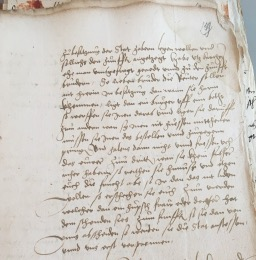
Among the sources I found, the contents of series AVES, AA 389 were of particular note. The series contains testimonies from rebels interrogated after the conflict in Summer 1525. The photographed document below is taken from the testimony of Wolf Gerstenwell, a vinedresser from the city of Saverne implicated in the uprising in the city of Spring 1525.
Gerstenwell seems to have been a particularly willing informant, and his testimony should be treated with scepticism. Still, it is one of the most detailed descriptions of a conspiratorial meeting I have found. In the segment photographed, he describes a speech attributed to a leading member of the vinedressers’ guild, Utz Karcher, who urged his guild brothers to oppose the city council’s decision to invite a company of Lothringian cavalry to garrison the city during the turmoil of that Spring.
Thanks to this source, and others like it, I have been able to make several inferences about conspiratorial meetings in guild parlours and to compare these to ones held in public taverns. This represents an important step for my research and will better enable me to gain a comparative perspective on conspiracy in different regional, social, and spatial contexts.
Emily Stokes:
Since my arrival in Berlin, I have attended an initial appointment at the Stasi Archive to survey the files made available to me thus far. These files contain information regarding surveillance of suspected homosexual men in the GDR, their contacts, movements, and activities. These files, and in particular, photographs contained within these files, remain a crucial aspect of my PhD project which looks to Stasi surveillance of queer minorities in East Germany in the 1980s.
I have also visited the Schwules Museum library in Berlin to collect visual material relating to private/artistic queer activities in the GDR, for example to view the collection of Jürgen Wittdorf, an East German artist whose work contained strong homoerotic inflections, and the pornographic albums of Siegmar Piske, a former-GDR resident who collected homoerotic images, sculptures, and mementos which filled his apartment, the entire contents of which was donated to the museum.
In addition, I have made visits to the Staatsbibliothek to collect images from several GDR magazines that could also be argued as homoerotic, as well as several museum collections including the German Historical Museum and Kulturbrauerei to view their GDR collection and search for any mention of the queer movement in East Germany. My research trip is ongoing however I am extremely grateful to the AGS for their contribution, which assists in the collection of material necessary to my PhD project.
Daniel Fraser:
In addition to giving me a working knowledge of the archive and its practices and regulations etc., my research visit to the Deutsches Literaturarchiv Marbach to examine the papers of Paul Celan was both rich and fruitful for developing my research.
By inspecting Celan’s original drafts and manuscripts, alongside certain workbooks, I was able to piece together components of Celan’s reading of, and engagement with, Walter Benjamin that I had been hitherto unaware of, giving me a great deal of insight into the theoretical and poetic material precipitated in Celan’s work as a result of his engagement with Benjamin. This adds a significant and explicit personal dimension to my project’s thesis that had been only a very slight peripheral element before these discoveries.
In addition, I was also able to find several secondary sources, including early English translations in privately printed volumes and small magazines, that I had not previously been able to access. These documents have filled in a great number of gaps in my knowledge regarding the reception of Celan in the English-speaking world, and one or two have provided vital critical insight into the place of time/history in Celan’s work that my project hinges on.
A final, subsidiary, outcome has been that the visit has put me in touch directly with the Celan estate, Bertrand Badiou and the poet’s son Eric, who have already been most helpful in making suggestions and advice for investigating Celan’s papers.
Solange Manche:
The AGS travel grant contributed to my stay at the Humboldt University (HU) for the 2020-2021 academic year. My thesis explores the link between contemporary French philosophy and the German tradition, in particular Marx and Hegel. I look at how the critique of contemporary capitalism in the works of Catherine Malabou, Bernard Stiegler, and Frédéric Lordon can help us understand the relation between finance and individuation. I attended the HU as a visiting scholar at the German department, on invitation of Prof. Dr. phil. Joseph Vogl whose work on financialisation informs my research.
As a visiting scholar, I got to attend and present one of my chapters at Vogl’s Kolloquium. My presentation sought to argue that Catherine Malabou’s notion of plasticity, which she develops primarily building on Hegel’s Philosophy of Mind, should be taken seriously, and can open new perspectives, in critical finance studies. My presentation was entitled “finance’s Phineas Gage: Thinking Financial Subject Formation with Contemporary French Thought.” Getting feedback from other PhD students from a different context has been invaluable, as well as connecting with other researchers and visiting scholars. Prof. Dr. Philipp Staab’s Kolloquium also gave me a chance to discuss the relation between finance and technology and to familiarise myself with the work of other scholars in Germany.
I was also very pleased to meet another visiting scholar of Vogl’s working on Bernard Stiegler, with whom I hope to be collaborating with for future projects. Overall, my stay in Berlin, despite the pandemic, has been an invaluable experience. My intention is to return to Germany after the PhD, and the AGS’ contribution to my academic year in Berlin has enabled me to build connections and to familiarise myself with local institutions and a vibrant intellectual community that will certainly help me realise this.
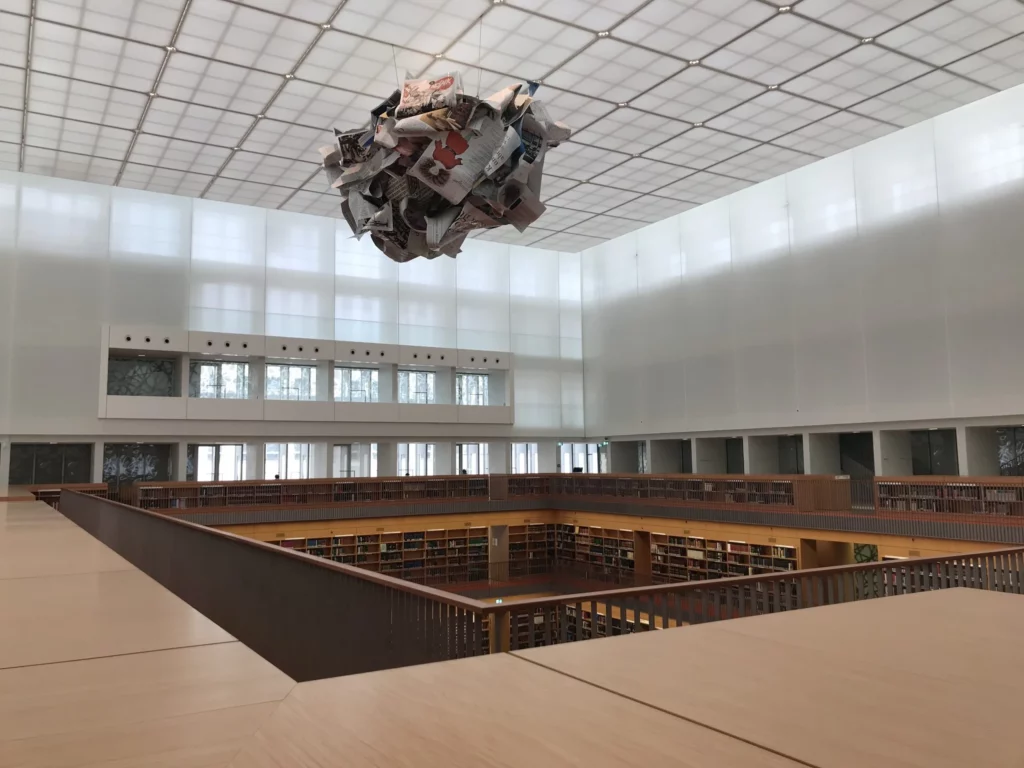
Below is a photograph of the newly renovated Staatsbibliothek on Unter den Linden, where I’ve had the pleasure to work.
Emma Buchanan:
Emma Buchanan, PhD student at Bangor University, attended the International Association for Jungian Studies at the Goethe University in Frankfurt with the support of the AGS, since we encourage the study of German-language writers and thinkers, broadly conceived. Emma’s paper explored the series The Walking Dead to show that the archetypal theme of rebirth is essential for survival in a so-called “trans-state” – the overarching theme of the Jungians’ conference.
Doreen Pastor:
The conference “Museums and their publics at sites of conflicted history” took place at the Polin Museum (Museum of Jewish History) from 12th-15th March in Warsaw. It included a variety of papers on the themes of cultural memory, memorial/museum management and visitor management. It provided me with the opportunity to engage with established researchers in my field, e.g. a lecturer from New York currently conducting research at Ground Zero or a current PhD researcher from the Netherlands carrying out visitor research at The Hollandsche Schouwburg (a Jewish deportation centre). The keynote by Professor Eyal Naveh “History Education in a Post-Conflict Area vs History Education in an in-Conflict Area: The Challenges of the Multi-Narrative Approaches” was a fascinating insight into the challenges of teaching history in Israel and Palestine; it assisted me in gaining an understanding of the Israeli background, an issue I encountered during my research at the House of the Wannsee Conference in Berlin.
My own presentation “I would have like to see a barrack – visitor experiences at two concentration camp memorials in Germany” sparked a lively debate about visitors to those sites. The conference was a great opportunity to present (and defend) my research in an international context and to receive constructive feedback about my research outcomes. Video links to my own presentation and other papers can be found here: http://www.polin.pl/en/conference-museums-and-their-publics. I am grateful for the funding from the Association for German Studies enabling me to attend this conference.
Maren Rohe:
Fieldwork conducted between 18 February and 15 April 2017 in Warsaw:
With the help of the AGS travel grant, I spent two months in Warsaw, Poland, conducting focus groups and individual interviews for my PhD. My research focuses on perceptions of Germany in Poland and Russia, in particular the relation between individual perceptions and media portrayals in both countries. I analyse country perceptions as narratives, looking at how individual and social narratives interact with larger scale societal meta-narratives on national identity and Othering. During this fieldwork period I conducted focus groups and/or individual interviews with 80 study participants. I gained access to my study population, university students from various fields through lecturers at three Warsaw universities, who were very helpful and supportive of my research. I was able to introduce my project in a number of university classes, and many of the students I talked to personally were willing and excited to participate in an academic research project. In this way, I was able to collect crucial data for my PhD, which I am now analysing and comparing to media stories as well as similar data collected in Russia.
Maria Roca Lizarazu:
Supported by the AGS travel scholarship, I paid a visit to the renowned Frankfurt Memory Studies Platform at the Goethe-Universität Frankfurt. The platform provides an international and interdisciplinary forum for memory studies research, bringing together established as well as emerging scholars in the field, with a special focus on issues of transculturality, mediality and narratology.
On the 22nd of November I gave a talk entitled “Thomas Mann in Furs. Remediations of Sadomasochism in Maxim Biller’s Im Kopf von Bruno Schulz”. My paper was based on my PhD research and examined the ways in which Maxim Biller’s latest novella resorts to literary and visual traditions of sadomasochism (Bruno Schulz and Leopold von Sacher-Masoch in particular) to negotiate the problematic German-Jewish symbiosis.
My talk was well-received and the ensuing discussion provided invaluable feedback, which will help with the final revisions of my chapter on Biller. I particularly enjoyed discussing my use of the concept of “remediation” with Prof. Astrid Erll, who is an expert on the topic.
Moreover, the trip to Frankfurt offered excellent opportunities for networking, as it enabled me to speak alongside a colleague from Warwick and meet various Frankfurt-based scholars with a background in memory and postcolonial studies as well as Anglo- and Francophone literatures and cultures. I hope to build on these connections in the future, and would like to express my gratitude to the AGS for its support.
See the conference poster here!
Kira Liebert:
The annual conference of the American Society of Eighteenth Century Studies in 2016 took place from March 30 to April 3 in the impressive William Penn Hotel in Pittsburgh, US. It was not at all surprising to learn that Angela Merkel had stayed there for the G20 Summit meeting in 2009. Not only the venue but also the size of the conference was impressive, with a total of 221 panels and roundtable discussions excluding lectures. Deciding between a dozen of parallel sessions was not always an easy task – many interesting papers were listed and relevant to my research on Karl Philipp Moritz, his Anglophilia and his role as cultural mediator between England and Germany in the late 18th century.
The paper I was presenting was part of the two-part roundtable discussion “On Foot: Walking in the Eighteenth Century” and was entitled “Travelling on Foot – Resentment and Choice in Karl Philipp Moritz’s Travels, chiefly on foot, through several parts of England, in 1782”. For the German Karl Philipp Moritz, travelling through England was never about collecting exact data for publishing a factual travel guide. Rather, he conducted his travels in the manner of Laurence Sterne’s Sentimental Journey — while reading his “Milton” and producing romanticized accounts of his adventures. For Moritz, these travels primarily entailed the possibility to obtain an experience without any boundaries and the freedom to walk wherever he wanted whenever he wished. Not many Germans had travelled to or written about England before, and his journey gives the reader extraordinary impressions of the English people and countryside. His decision to travel on foot did not serve a particular purpose like a pilgrimage might, and it can be seen as a means of self-discovery and self-experience (much like in Jean-Jaques Rousseau’s Les Rêveries du promeneur solitaire). However, Moritz’s decision to walk was accompanied by lots of restrictions and hostility. “[T]hose who rode, or drove, past me, stared at me with astonishment; and made many significant gestures, as if they thought my head deranged” and “when [he] passed through a village, every old woman testified her pity by an exclamation of – Good God!”; Furthermore, he was often told “without any apology […] that they had no intention of lodging [him], as they had no room for such guests […].” Given such hostility, why was Moritz travelling on foot? Additionally, the network of “turnpike roads” around London was by this time well-developed, and Moritz himself discusses the dangers of “foot pads [who] murder in the most inhuman manner, for the sake of only a few shillings, any unfortunate people who happen to fall in their way”, making travelling on foot seem extremely hazardous. In my paper, I was examining the hostility Moritz received on his journey (emphasized by rude treatment and scornful glances) as well as his compulsion to travel on foot under those hard and dangerous conditions instead of simply using the much faster and comparatively safe coaches.
Although a great number of the papers that were given at this roundtable were focussed on Jane Austen’s works and my paper on Moritz was clearly situated at the earlier end of the panel, similarities between all papers could be found with respect to the individual purposes of the walking travellers – for example in their love of nature, the aesthetic discourse of the picturesque, the act of walking as source of privacy, reflection, contemplation and intellectual resolution, but also in the descriptions and awareness of social rank and the disadvantages that travelling on foot involved. Unfortunately, time for discussion was quite restricted and besides a more general question regarding Moritz’s Anglophilia the focus of the audience was mainly on the papers dealing with Jane Austen’s works.
For my current research on Moritz’s reception of English authors and their literary works the panel on “Milton in the Long Eighteenth Century” was particularly beneficial. Although the papers given were quite specific and also dealt with Milton’s less well-known works they certainly gave me an insight into Moritz’s fascination with this English author. Panels like “The Passions and Eighteenth-Century Aesthetics” by the Cultural Studies Caucus and “News, Media and Information Systems in Eighteenth-Century Europe” provided a rather broad variety of papers from “The Learned Pig” to “Tracking Rumors, Making News” and left me with some new (and slightly bizarre) knowledge.
My two personal highlights were a talk from Gordon Turnbull (Yale University) on “James Boswell and a Theory of ‘Natural’ Quotation” – learning about his connections to Samuel Johnson as well as Thomas Sheridan and about the quotation as the most natural human habitude – and a lecture by John Brewer (California Institute of Technology) with the title “Fire and Ice: Travel and the Natural Sublime in the Age of Enlightenment” which was enriched with illustrations and quotes of travel descriptions concerning volcanoes and mountains. Both speakers certainly knew how to capture the attention of their audience and to spread interest for their research. In general, the most positive aspect of the conference was the variety of research backgrounds the presenters came from, allowing the attendees to discover new interdisciplinary connections and visualize a more accurate picture of the long eighteenth century with regard to their own research.
All in all, it was a great conference that provided me with new insight and inspiration concerning my research as well as helped me gain some experience with presenting my academic work in front of larger groups and therefore definitely made up for the long travel days.
Judith Vonberg:
The AGS travel scholarship enabled me to spend two weeks in Germany carrying out research for my thesis on the fictional depiction of Britons and Germans in British and German popular culture between 1945 and 1965. I spent a week at the national library in Leipzig where I looked at copies of East and West German television and radio schedules, popular magazines such as Revue, Stern and Bunte, lots of East and West German pulp fiction and countless issues of West Germany’s tabloid newspaper, BILD. These were all invaluable in improving my understanding of Germany’s popular engagement with the idea of Britain in both fictional and non-fiction contexts.
I spent my second week in the Berlin film archive watching films that are not available online or on DVD. These included East German films Der junge Engländer and Nebel and the West German films Die Rote and Bezaubernde Arabella. These were very popular films in the post-war period and my understanding of how Britons were depicted has been significantly expanded as a result of viewing them.
Having completed my trip, I am now far better positioned to write the remaining two chapters of my thesis, which examine the depiction of Britons in German popular culture in the immediate post-war period.
Jeannine Jud:
I attended The GDR Today II, a two-day postgraduate colloquium held at the university of Bristol, on the 10th and 11th of September 2015. A follow up to the GDR Today, held at the University of Birmingham in January 2014, this colloquium gave new and returning postgraduate students the opportunity to introduce their research or demonstrate the development of their research since the previous colloquium held eighteen months earlier. This two-day event focused on the history and memory of GDR culture, society and politics, and brought together researchers from the areas of literature, history, sociology, theatre and translation. The interdisciplinary insights and perspectives discussed at this event were particularly valuable for my own research. Furthermore, each participant received feedback from an expert in their area of research. I presented my paper entitled “Re-Evaluating the Literature of Christa Wolf: Patterns of Conformity, Memory and Identity in Kindheitsmuster and Stadt der Engel oder The Overcoat of Dr. Freud” in the panel: “Revisiting GDR Literature”. The feedback I was given in response to my paper is invaluable at this stage of my research and provided me with new insights and challenges regarding my own work. I am immensely grateful for having been given the opportunity to attend and present at this event, to meet other researchers working in the same field and gain new perspectives into this fascinating historical era.
Michael Kranert:
The generous AGS travel scholarship allowed me to travel to the ‘DiscourseNet Congress #1 – Discourse: Language, Society, Critique’ held at the University of Bremen on 24th-26th September 2015.
DiscourseNet (http://www.discourseanalysis.net) is a Research Network that aims to connect European discourse researchers in a multitude of academic fields, from sociology to linguistics, in order to facilitate promote the exchange of ideas in the field of discourse studies across the disciplinary and national traditions. As a discourse linguist who is influenced by the British tradition of critical discourse analysis and the German tradition of polito-linguistics, the DiscourseNet Congress was the ideal event to present ideas from my PhD research to a subject specific audience and to network with other researchers in the field.
My paper ‘The Construction of Leadership and Group Identity in Leader’s Speeches at Party Conferences of Labour Party and the SPD’ was well received, as I was fortunate to be able to present in a panel that included papers thematically very close to my own, such as Naomi Truan’s ‘Addressing the nation, avoiding the confrontation? The third person as a disguised form of address in New Year’s messages of the British Prime Ministers and the German Chancellors (1998-2015)’. This allowed an intensive discussion about the use of personal pronouns in political speeches and the advantages and disadvantages of quantitative methods in discourse linguistics.